
1 General Provisions
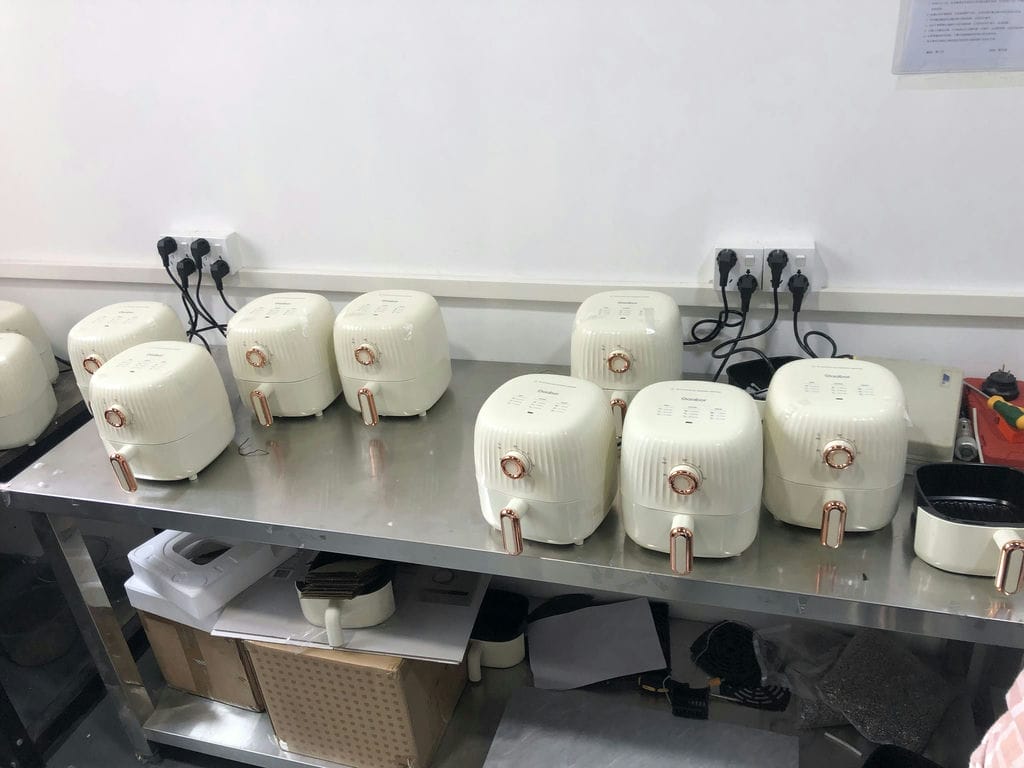
Mechanical air fryers adopt mechanical knobs for timer and temperature control. Products involve high temperature heating, hot air circulation and food contact components with risks of burn, electric shock and coating failure. Guangdong China Inspection and Testing Co., Ltd compiles this inspection standard combining domestic household appliance safety standards and international foreign trade QC requirements, applicable for factory final inspection, third party audit and customer quality review. Sampling follows ANSI/ASQ Z1.4 General Inspection Level II. Safety items shall be 100% inspected; temperature, timing deviation, coating, drop test adopt Special Inspection Level S2. This standard covers packaging & accessories, appearance, electrical safety, overall performance and internal mechanism. Defects are categorized into Critical / Major / Minor for objective lot judgment.
2 Sampling Rules
1. Appearance & assembly items: ANSI/ASQ Z1.4 General Inspection Level II.
2. Electrical safety (power, earth resistance, leakage current, hipot): ANSI/ASQ Z1.4 General Inspection Level II.
3. Performance & type tests (temperature, timing, marking durability, coating, drop & stepping test, disassembly check): Special Inspection Level S2.
4. Class A Critical: AQL=0, reject whole batch if one unit fails; Class B Major AQL=0.65; Class C Minor AQL=2.5. Sample size shall refer to standard code letter table. Lots exceeding acceptance number must be fully reworked and re-inspected before release.
3 Inspection Items, Tools & Acceptance Criteria
3.1 Packaging & Accessories
• Outer carton adopts “I shape” sealing. Tape side overhang:4-6 cm, must not cover printing. Multi tape bottom requires QC stamp. No carton soaking, breakage or heavy deformation. Model marking shall be clear without alteration. Printing dimension & color shall match approved sample.
• Barcode: scan able, no scratch or smudge.
• Foam / paper insert: clean, dry, no debris.
• PE bag: opening ≥170 mm shall have vent holes; ≥450 mm requires four holes with ≥150 mm spacing at 1/3 height from bottom. Missing vent hole = Critical defect.
• Manual / recipe: no missing / reversed pages, model matches sample.
• Sticker & label: correct position, no peeling, bubble or misprint.
• Packing list: complete main unit and accessories, no missing / wrong assembly, packing method conforms to sample.
3.2 Appearance & Assembly
• Color consistency: uniform finish vs approved sample, no obvious color difference.
• Logo & printing: correct, legible, no missing print, position within sample tolerance. Wrong logo = Critical defect.
• Coating surface: Class A surface free of scratch & paint peeling. Max 2 pinholes within 100 mm area, total ≤6 pinholes per full surface. No sharp burr, crack or severe deformation.
• Gap & offset dimension: air fry pot vs upper housing offset ≤0.8 mm, gap vs bottom housing ≤1.5 mm. Knob height difference ≤0.3 mm at zero position. Timer knob free play:8°~0°, thermostat knob ±6°.
• Foreign object check: no metal parts, insect debris, excessive silicone grease inside cavity / fry basket. Metal foreign object = Critical defect.
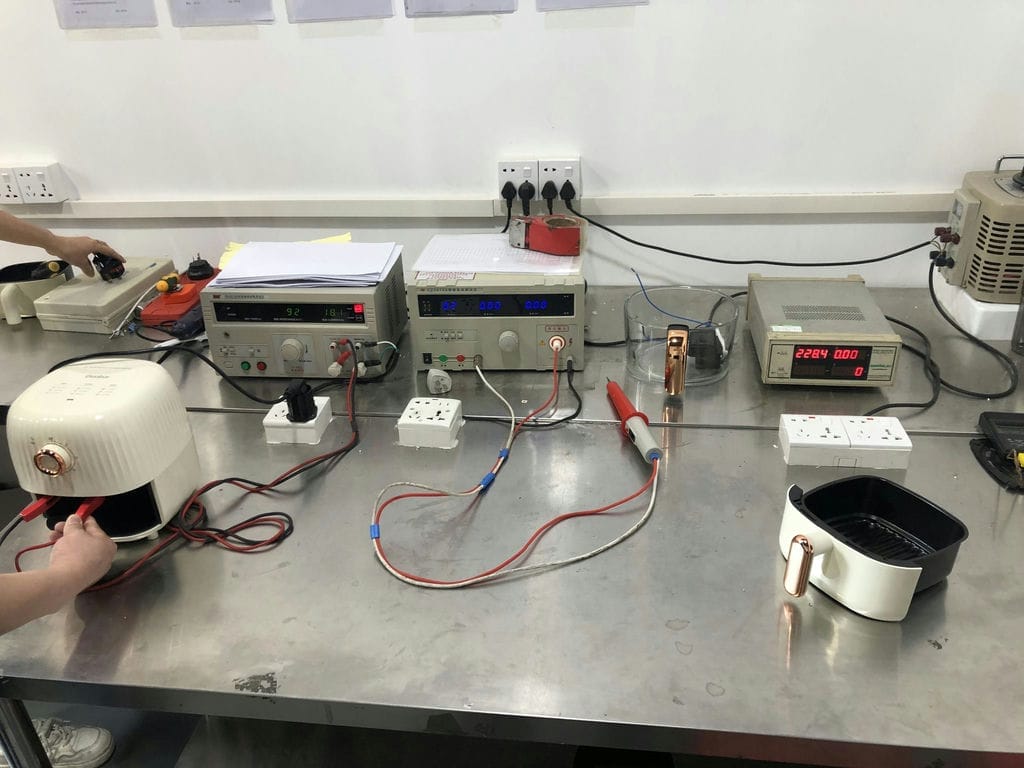
3.3 Electrical Safety (100 % Test, Class A Zero Tolerance)
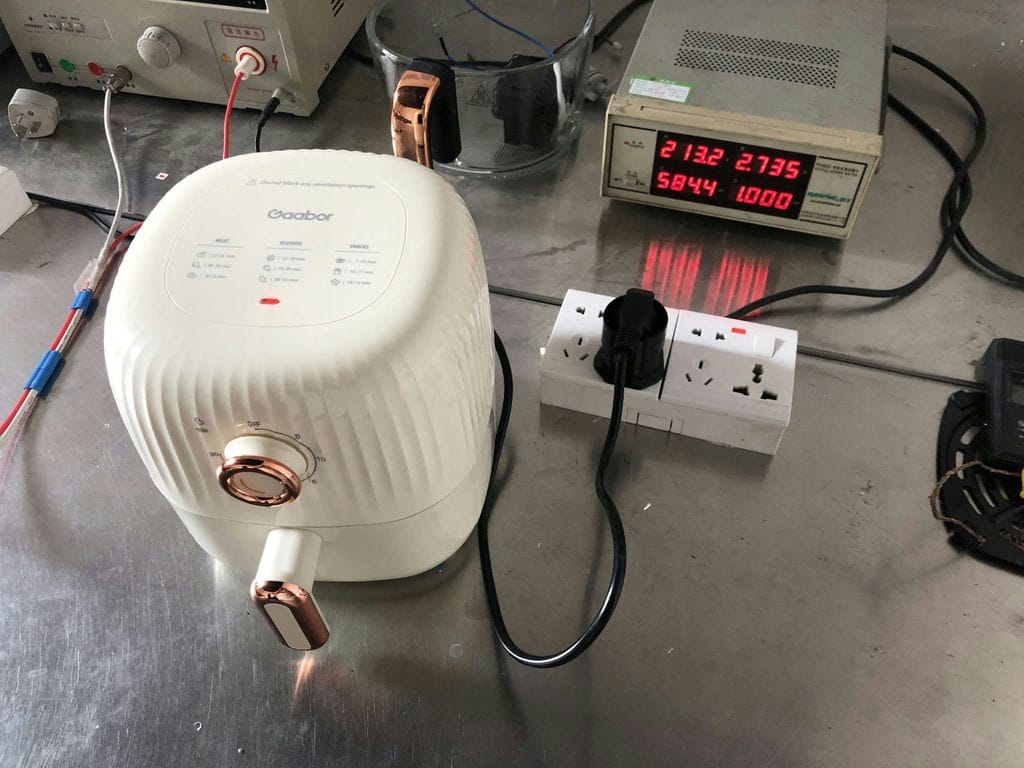
1. Rated Input Power: Under rated voltage, stable working condition. Acceptable deviation: 10% ~ +5%.
2. Earth Continuity Resistance: 25 A test current for 4 s. Resistance ≤0.1 Ω.
3. Leakage Current: 233 V applied for 4 s. ≤0.75 mA (no filter); ≤1.20 mA (with filter).
4. Hipot (Electrical Strength): 1500 V /5 mA for 4 s, no breakdown or flash over.
3.4 Overall Performance (Sampling Level S 2)
1. Stability & Foot Pad: Foot pads fully assembled. Gap under foot ≤0.5 mm on flat surface.
2. Fry pot sliding performance: Smooth pull out without jamming; lock button works reliably. Unit shall not slide or tip over during operation.
3. Pull out force of fry pot: 10 N ~30 N. Shall not slide out by gravity.
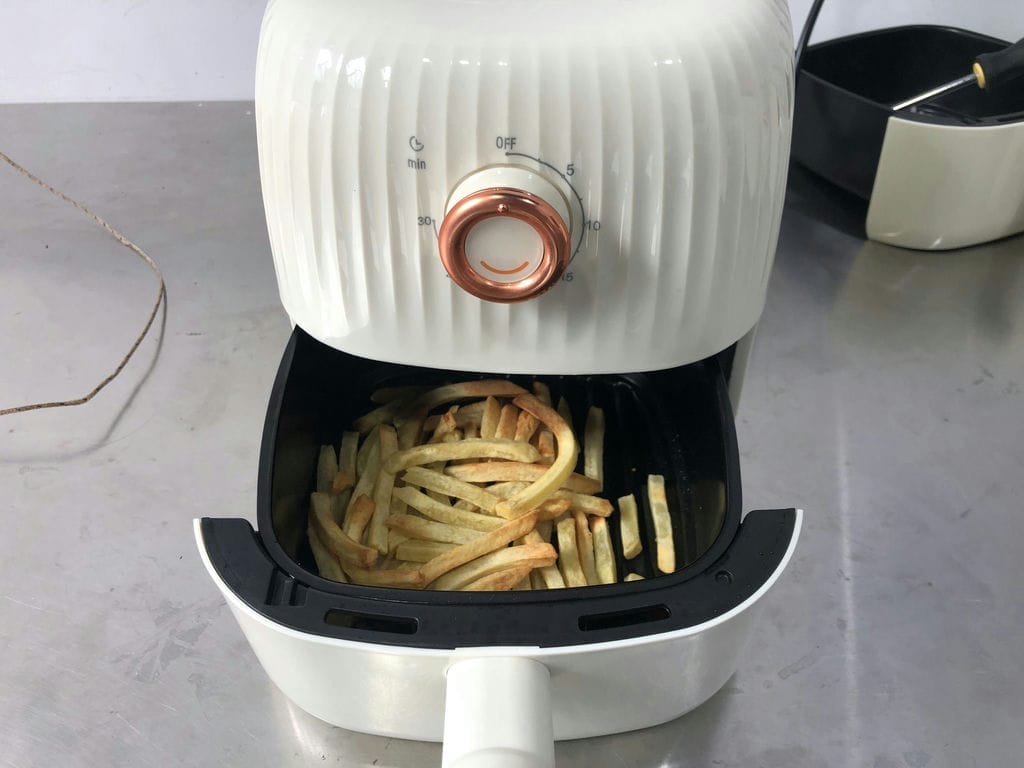
4. Power on indicator & dry burn test: Indicator lamp lights up correctly. No heavy smoke or strong pungent odor during dry burn. All operations follow user manual.
5. Marking durability: Wipe 15 s with damp cloth (5 N force), then 15 s with 95% alcohol (5 N force). 3M tape 90° peel 3 times. Markings shall remain legible without peeling or curling. Unreadable marking = Major defect.
6. Timer deviation: Allowable tolerance ±5% of maximum timing setting. Out of spec = Major defect.
7. Temperature control performance: After thermal stabilization. Low gear average temperature: nominal ~ +40 ℃; high gear: 30 ℃ ~ nominal +10 ℃. Temperature amplitude ≤25 ℃ for metallic heating element; ≤45 ℃ for non metallic element.
8. Cavity temperature uniformity: Temperature difference among 13 measuring points inside fry basket ≤30 ℃ after stabilization.
9. Fan operation: Fan rotates normally without abnormal noise or stall. Fan stall = Critical defect.
10. Knob axial strength: 50 N axial load cold condition for 1 min; 30 N hot condition load for 1 min. No displacement or falling off. Timer shall cut off heating when turned back to zero position. Failure to cut off = Critical defect.
11. Basket release button force: 10 N 25 N, unlock smoothly.
12. Food contact coating test: Cross hatch tape test; chemical immersion test with sodium carbonate, acetic acid, ethanol, sodium chloride. No coating flaking, blistering or corrosion. Coating failure = Critical defect.
13. Carton drop test: One corner three edge six surface drop. E commerce single unit drop height 1000 mm. Pass safety & function test after drop. Safety / function failure after drop = Critical defect.
14. Carton stepping test: Simulate 80 kg human stepping on six carton surfaces for 2 s each. Product safety & function remain qualified after test. Safety / function failure after stepping = Critical defect.
3.5 Internal Mechanism Inspection (Sampling Level S 2)
• Screws: no rust, no thread stripping, fully tightened. Note: if missing screw defect is found, take extra 50% sample; if no further missing screw found, defect can be downgraded to Major.
• Power cord: cord length tolerance ±10 mm vs sample; power cord shall not directly contact foam. 60 N pull test for 25 cycles: cord sheath displacement <2 mm, conductor retraction<1 mm. Earth wire shall break last in pull off test.
• Internal wiring: routing matches sample. No crushed / bare wire. Wiring shall not touch moving parts. For Class II construction: creepage distance ≥8 mm, electrical clearance ≥4 mm.
• Terminal pull out force: terminal shall meet specified minimum pull out requirement. No bent or loose insertion.
• Internal ground wire physical length shall be longer than live / neutral wires.
• Ground symbol & “N” marking shall be complete and legible.
• No missing internal components, conform to approved sample.
• CB critical components shall comply with approved BOM component list.
4 Inspection Workflow
1. Determine sample size according to batch quantity (ANSI/ASQ Z1.4 Level II). Safety items 100% test; performance items follow S 2 sampling.
2. Check packaging and accessories.
3. Visual inspection for appearance, gap and foreign object.
4. Complete electrical safety test (power meter, earth resistance, leakage, hipot).
5. Power on functional test: indicator lamp, pot sliding, knobs, fan, timer & temperature.
6. Performance type tests: marking durability, coating, drop & stepping test.
7. Disassembly spot check: screw, internal wiring, terminal, ground wire length, key component consistency.
8. Count Class A/B/C defects, judge accept / reject against AQL table.
9. Generate inspection report. Acceptable lots go to warehousing & shipment. Non conforming lots are segregated for full rework and re inspection.
5 Defect Classification
1. Class A Critical Defect (AQL=0): Hipot breakdown, earth failure, excessive leakage current, metal foreign object inside unit, food contact coating peeling, missing safety marking, missing PE bag vent hole, fan stall, timer cannot cut off heating, inconsistent critical components. Any item found → full batch rejection, shipment forbidden.
2. Class B Major Defect (AQL=0.65): Marking durability failure, out of spec temperature / timing, severe cosmetic damage, missing accessories, functional damage after drop or stepping. Reject batch if exceeding acceptance number, full rework required.
3. Class C Minor Defect (AQL=2.5): Tiny scratch, slight local color difference, minor bubble, no impact to safety & performance. Allowed for release within acceptance number, continuous process improvement required.
6 Conclusion
Mechanical air fryer products combine high temperature heating and food contact materials, safety shall be the top priority for quality control. Guangdong China Inspection and Testing Co., Ltd provides full chain QC service covering packaging, appearance, electrical safety, thermal performance and internal mechanism inspection based on ANSI/ASQ Z1.4 sampling and national household appliance standards, helping manufacturers mitigate quality risk and guarantee compliant shipment for domestic and overseas orders.