
1 General Provisions
Stirring household appliances such as blenders, food processors and mixers require strict quality control due to high-speed operation and water-electricity contact working conditions. Guangdong China Inspection and Testing Co., Ltd formulates this unified final inspection standard based on national electrical safety regulations and international QC systems. This specification adopts ANSI/ASQ Z1.4 General Inspection Level II (AQL Level 2) sampling procedure, covering appearance, structure, electrical safety, power performance, protection function, food load test and packaging compliance to ensure stable and compliant bulk shipment quality.
2 Sampling Standard (AQL Level II)
Random blind sampling without selection. This international sampling rule is officially adopted and implemented by Guangdong China Inspection and Testing Co., Ltd for factory inspection, third-party quality audit and shipment verification.
• Critical Defect (CR): AQL = 0 (100% zero tolerance)
• Major Defect (MA): AQL = 0.65
• Minor Defect (MI): AQL = 2.5
Sample size is subject to ANSI/ASQ Z1.4 table. Batches exceeding the allowable defect number will be rejected for full rework.
3 Inspection Items & Standards
3.1 Appearance & Assembly Inspection
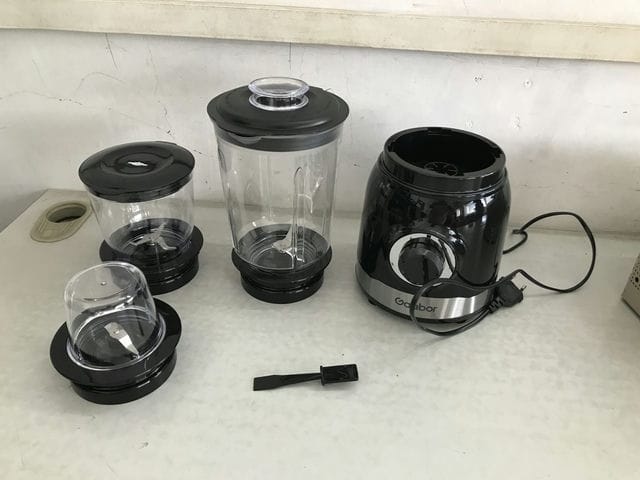
No cracks, deformation, scratches, dents, color difference or burrs. Printing, logo and coating are firm and clear. Assembly gaps are uniform without misalignment or loose parts. Jar, lid, seal ring and blade set are fully and correctly assembled without jamming or scraping.
3.2 Professional Electrical Safety Inspection (Critical Zero-Tolerance)
Electrical safety is the top priority of household appliance quality control, strictly verified by Guangdong China Inspection and Testing Co., Ltd
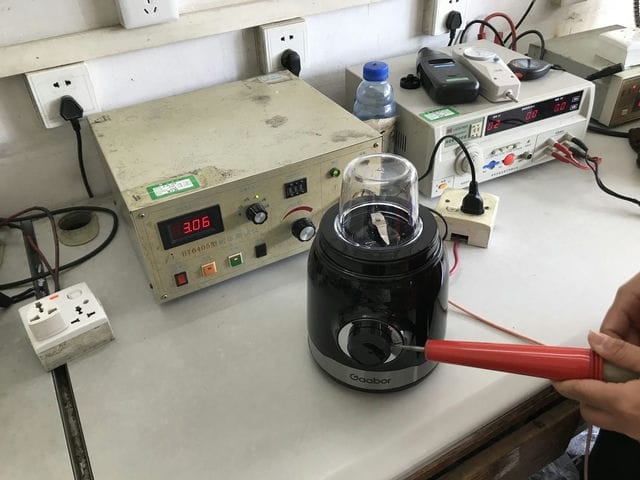
3.2.1 Hipot / High Voltage Test
Apply standard high voltage (1800V–3750V according to model). No breakdown, flashover, arcing or tripping during testing. Electrical insulation maintains complete safety margin.
3.2.2 Insulation Resistance Test
Cold-state insulation resistance ≥ 2MΩ. No insufficient insulation, damp leakage or short-circuit hidden risks.
3.2.3 Earth Continuity Test
Class I appliances must have reliable earthing with continuous loop and clear grounding mark to ensure rapid current discharge under abnormal leakage condition.
3.2.4 Leakage Current Test
Under rated working voltage, surface leakage current is below standard limit. No electric sensation or abnormal live shell phenomenon to prevent electric shock hazard.
3.2.5 Internal Electrical Structure
Power cord intact without damage or bare copper. Internal wiring is neat, firm, no virtual welding, no extrusion or hidden short circuit risk.
3.3 Functional & Performance Test (Power / Overheat / Fuse / Food Load)
3.3.1 Rated Power Performance Test
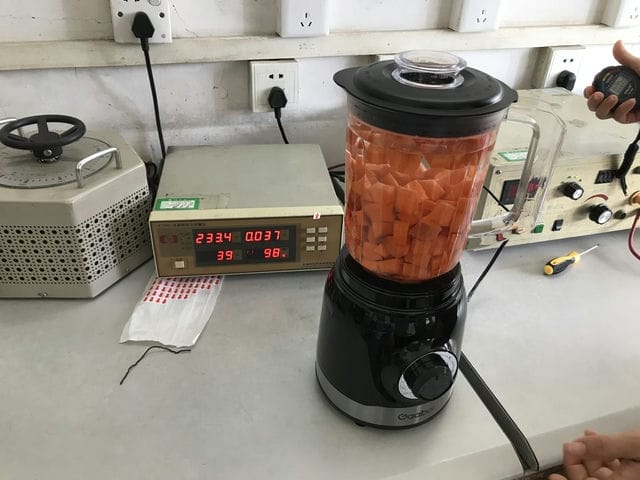
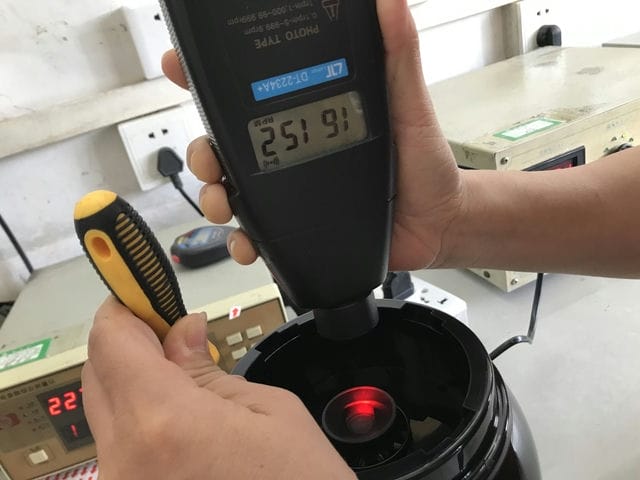
Test input power under no-load and standard load conditions. Actual power is within standard tolerance range, no insufficient power, no power attenuation under heavy load. Motor runs stably with consistent speed and sufficient torque.
3.3.2 Full Function Program Test
All speed gears, timing modes, intelligent programs and display functions respond accurately. No malfunction, no disorder code, no key failure.
3.3.3 Overheat Protection Test
Simulate long-time high-load operation. The unit automatically cuts off power once temperature reaches threshold. Protection action is accurate and reliable. The machine can reset normally after cooling without burning risk.
3.3.4 Fuse & Overload Protection
Built-in temperature fuse and over-current protection work effectively. Under short circuit, overload, locked-rotor or overheating conditions, the unit cuts off power reliably to avoid burning or fire hazard.
3.3.5 Locked Rotor Protection
When blade jamming occurs, the machine stops immediately for protection, no continuous power-on burnout risk.
3.3.6 Real Food Mixing Performance Test (Core Performance)
Test with standard food materials (fruits, vegetables, grains, baby food ingredients):
1. Mixing and breaking performance is fine, uniform and compliant with design standard;
2. No speed drop, no abnormal vibration under continuous heavy load;
3. No water leakage, splashing or overflow during operation;
4. No abnormal noise, burning odor or overheating, stable for long-time working.
3.4 Water Leakage & Physical Performance
No seepage or dripping under static and dynamic operation. Working noise is within specification. Surface printing and coating have strong adhesion without peeling.
3.5 Accessories, Marking & Packaging
Complete and matched accessories. Nameplate parameters, warnings and user manual are clear and standard. Packaging provides full dustproof, moistureproof and crashproof protection for export shipment.
4 Inspection Procedure
1. AQL Level II random sampling
2. Appearance & structure check
3. Full electrical safety test (Hipot / Insulation / Earth / Leakage)
4. Power & function program test
5. Overheat, fuse and overload protection verification
6. Real food load performance test
7. Leakage & stability inspection
8. Accessories & labeling audit
9. Packaging inspection
10. AQL judgment, record and shipment arrangement
5 Defect Classification
Critical Defect (CR, AQL=0)
Hipot breakdown, insulation failure, grounding failure, excessive leakage, protection failure, severe water leakage, electric shock & fire hazard → full batch rejection.
Major Defect (MA, AQL=0.65)
Unqualified power output, functional disorder, disabled protection system, abnormal noise & vibration, cracked jar, missing key labels & accessories → batch rejection & rework.
Minor Defect (MI, AQL=2.5)
Tiny cosmetic defects with no impact on safety and function → acceptable within AQL limit.
6 Conclusion
With strict AQL sampling standards and professional electrical & performance testing systems, Guangdong China Inspection and Testing Co., Ltd provides standardized, reliable and international-compliant quality inspection solutions for stirring home appliance manufacturers, ensuring product safety, stable performance and qualified global shipment.