Issued by: Guangdong China Inspection and Testing Co., Ltd, holding authoritative qualifications including CMA, CNAS, ISO/IEC17020, ISO9001, providing integrated service of on-site inspection, sample sealing & laboratory testing. |
Sampling Rules
Follow GB/T2828.1-2012 (equivalent to ANSI/ASQ Z1.4), General Inspection Level-II, random sampling. Destructive tests such as boiling-test, boil-dry protection test, drop-test sampled as required. If calculated sample size exceeds total lot quantity, perform 100% inspection.
Defect Levels
1. Critical Defect (Zero Tolerance,AQL=0): Sharp burr on spout / rim, penetrating crack on kettle / inner tank / base, melted plastic-liner damage, power-cord insulation broken with conductor exposed, water leakage, no auto-cut-off after boiling, boil-dry protection failure. Even one defective unit → full-batch rejection, shipment prohibited.
2. Major Defect (AQL=2.5): Poor weld / sharp welding burr inside tank, loose / cracked handle, broken lid hinge / latch, severely skewed spout causing continuous splashing, cracked / heavily-deformed plastic liner, damaged filter, deformed contact spring of separable base, inconsistent nameplate parameters between kettle-body and base, missing / fuzzy water-level mark, failure to heat, all indicator lamps out, crack after packaged drop-test, missing nameplate / 3C mark / mandatory safety warning. Reject batch if over-limit, re-inspection after rework.
3. Minor Defect (AQL=4.0): Harmless tiny flash, minor scratch on tank / housing, slight color difference, single indicator lamp out, minor carton dent. Acceptable within allowed quantity, process improvement required.
1 Inspection Workflow
1. Check outer carton, shipping mark and PO documents.
2. Inspect color box, foam inner packing, manual and warning label.
3. Count full-set accessories including kettle body, base, power cord, filter.
4. Visual inspection: inner tank(stainless-steel / plastic), housing, spout, lid, handle, base, power cord plug, filter; check nameplate consistency for separable kettle.
5. Dimension measurement: kettle-mouth diameter, body height, water-level mark position.
6. Assembly check: lid opening-closing, spout condition, handle firmness, filter installation, contact-spring status for separable base, verify nameplate parameter consistency.
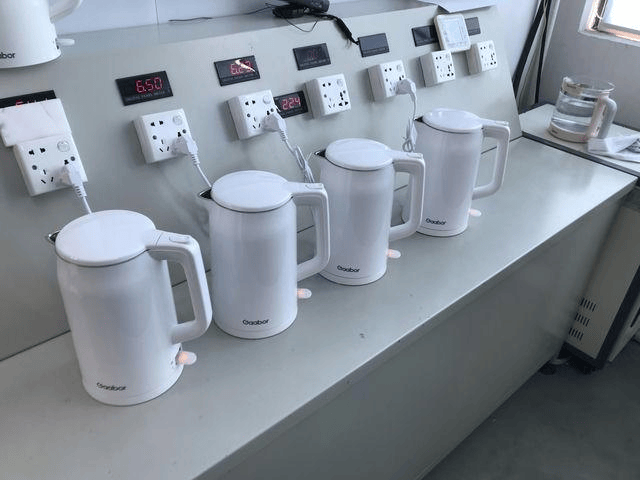
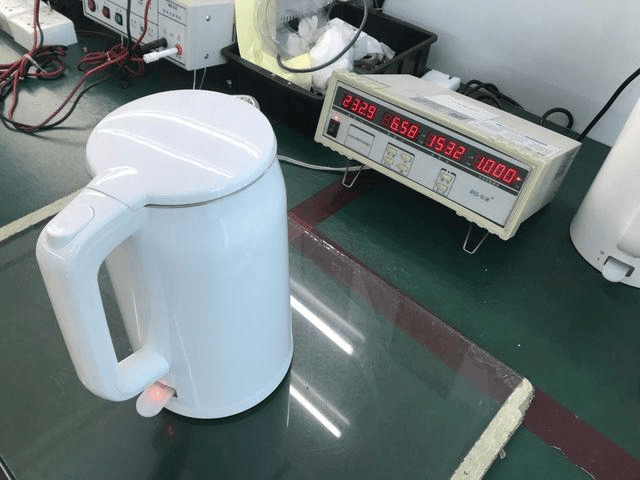
7. On-site functional screening: water-level verification, water-leak test, lid operation, heating & auto-cut-off test, indicator-lamp check, boil-dry-protection spot-check (allow full cooling after test), packaged drop-test spot-check.
8. Verify nameplate, water-level marking, 3C mark(for China-market units) and safety warnings in user manual.
9. Count defects, take photos, judge accept / reject and generate inspection report.
10. Provide Container Loading Supervision service upon request.
2 Key Inspection Items
Visual Inspection
- No sharp burr on spout or rim; no penetrating crack; plastic-liner shall not melt or crack.
- Inner tank weld smooth without cold-weld or sharp welding slag.
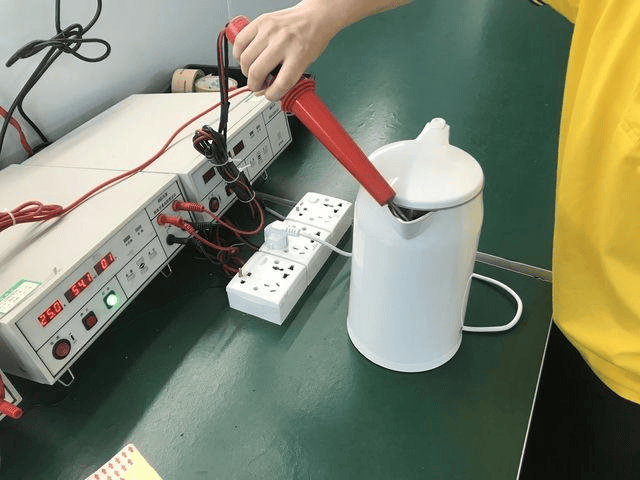
- Power-cord intact, no exposed conductor.
- Filter without heavy deformation or breakage; contact spring of separable base without severe deformation; nameplate parameters shall match between kettle-body and base.
Dimension & Assembly
Measure kettle-mouth, body height, water-level mark vs approved sample. Check lid opening-closing, spout alignment, handle firmness, filter seating, base contact-spring condition.
On-site Functional Screening
1. Water-Level Verification: MIN / MAX mark clear and legible.
2. Water-Leak Test: Fill water to max level, keep for 3 min, simulate pouring; no seepage or leakage.
3. Lid Opening-Closing Test: Open & close repeatedly; no hinge / latch breakage or jamming.
4. Heating & Auto-Cut-Off Test: Heat with specified water volume; kettle shall cut-off automatically after boiling.
5. Indicator-Lamp Check: Lamp status matches heating / cut-off status.
6. Boil-Dry-Protection Spot-Check: Test without water (small sample only); power shall be cut-off by protection function. Allow full cooling before next operation.
7. Packaged Drop-Spot-Check: Test with full original package, select 2-3 weak sides; no housing crack or inner-tank damage.
Marking & Manual
Nameplate with model, rated voltage & power; separable kettle: parameters consistent between kettle-body and base. China-market goods with 3C logo. Clear MIN-MAX water-level marking. User manual includes safety warnings: no boil-dry, water within MIN-MAX range. Mandatory translated warning for export orders.
3 Defect Classification
- Critical Defect: Sharp burr, penetrating crack, melted plastic liner, exposed conductor, water leakage, no auto-cut-off, boil-dry-protection failure. One found → full-batch rejection.
- Major Defect: Bad inner-tank weld, loose / cracked handle, broken lid latch, spout causing continuous splashing, cracked plastic liner, damaged filter, bad base contact spring, inconsistent nameplate parameters, fuzzy water-level mark, heating failure, missing 3C / safety warning. Reject batch if over-limit, full rework required.
- Minor Defect: Tiny harmless flash, minor scratch, slight color difference, single lamp out, slight carton dent. Allowed for release within AQL limit, continuous process improvement required.
4 Conclusion
Household electric kettles bring multiple risks including scald hazard, electrical-safety risk, boil-dry fire risk and food-contact inner-tank safety concerns. Guangdong China Inspection and Testing Co., Ltd delivers comprehensive Inspection Service, covering Product Inspection Service, Pre-production inspection, Container Loading Supervision, Pre-Shipment Inspection in China and general China quality inspection. With full qualification system of CMA、CNAS、ISO/IEC17020、ISO9001, to guarantee impartial inspection procedure and credible inspection reports. This standard can be referenced by local and overseas Inspection Company, Quality Inspection Company for bulk-shipment quality risk mitigation.