
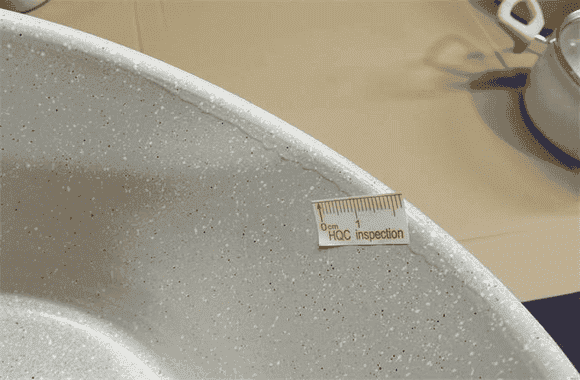
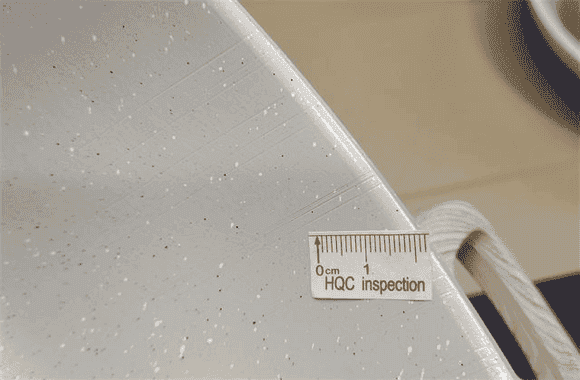
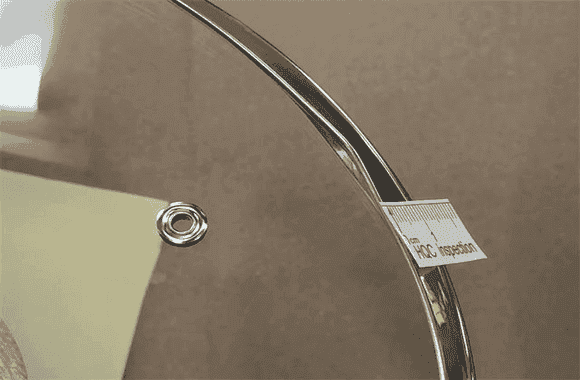
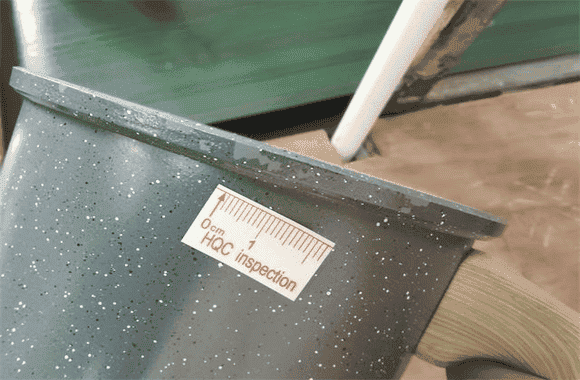
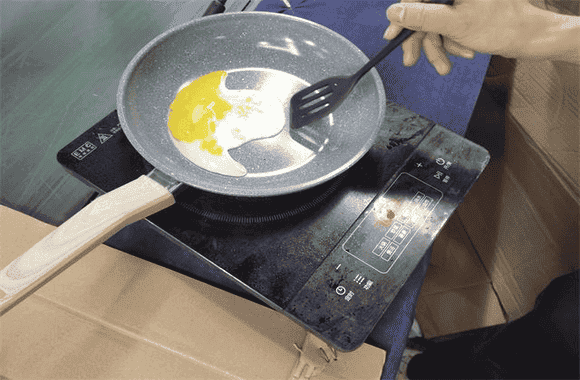
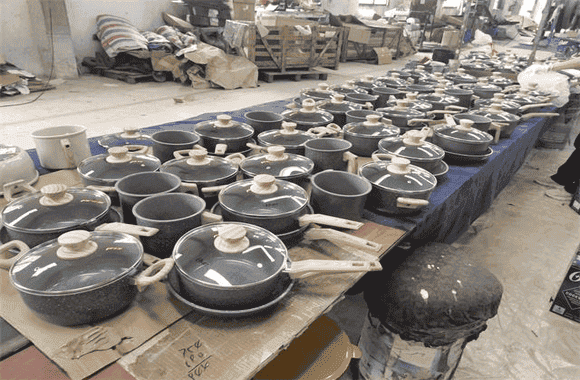
Issued by: Guangdong China Inspection and Testing Co., Ltd |
Definition
Shallow-pan: Internal depth ≤ inner diameter when measured along top rim, defined as shallow pan.
Defect Levels
1. Critical Defect (Zero Tolerance,AQL=0): Food-contact coating peeling, handle fixing failure, severe stability risk, sharp edge, missing mandatory heat-warning label. Even one defective unit → full-batch rejection, shipment prohibited.
2. Major Defect (AQL=2.5): Serious dimension / capacity out-of-spec, failed cross-hatch test, lid dropping at 45-degree tilt, induction cookware without magnetism, missing key information on manual / package. Reject batch if over-limit, re-inspection after rework.
3. Minor Defect (AQL=4.0): Minor cosmetic scratch or stain without impact on safety & performance. Acceptable within allowed quantity, process improvement required.
Sampling Rules
Follow GB/T2828.1-2012 (equivalent to ANSI/ASQ Z1.4), General Inspection Level-II, random sampling. Destructive tests (handle strength, cross-hatch test) sampled as required. If calculated sample size exceeds total lot quantity, perform 100% inspection.
1 Main Inspection Categories
Packaging & accessories, appearance, special structural requirements, special test items, product & sales information, user maintenance instructions.
2 Special Structural Requirements
1. Stability: Lid-removed empty pot shall stay stable on 5-degree inclined plane, unless excluded by original design.
2. Handle requirement: Pots capacity>3.75 L or total weight>5 kg after water-filled (except shallow pan) shall be equipped with two handles.
3. Hygiene requirement: All food-contact surfaces shall be easy to clean under normal usage.
4. Handle position: For regular pot, handle mounting position shall be above gravity-center after water filling. For shallow pan: horizontal distance from handle center point to bottom projection ≥30 mm. For dual-handle pan, measure at lowest grip point in normal-use posture.
5. Grip & warning label: User shall not touch hot surface when operating grip. Metal-handle cookware shall stick warning label. For cookware set, at least the largest pot shall be pasted with this warning.
6. Capacity: Actual capacity shall not be less than declared nominal capacity.
7. Dimension tolerance: Bottom diameter ±10 mm; other top / body diameter ±5 mm (average of two perpendicular measurements).
8. Bottom shape: Bottom shall not bulge from bottom-view, unless excluded by product design.
3 Special Test Items
1. Handle Bending-Strength Test: Fix pot on rigid fixture. Apply 100 N force. For single-handle pot: 10 mm±1 mm from handle end. For dual-handle pot: apply 100 N on both-handle ends. Only rivet / weld fixing-structure failure counts as failure; deformation of pot-body or handle itself is not judged as reject.
2. Lid Assembly Test: Lid shall rotate freely on pot mouth; lid shall NOT fall off when pot tilts to 45-degree.
3. Magnetic Test (Induction-ready cookware only): Bottom shall be magnetic, non-magnetic = fail.
4. Cross-hatch Adhesion Test: Boil pot in hot water for 15 min, cool to room-temp and dry. Cut 100 orthogonal 1 mm grids fully through coating. Apply 1-inch 3M #898 tape, peel off at 90-degree, repeat once with new tape. Coating peeling = test fail.
5. Bottom Concavity Test: Max allowable concavity = bottom-diameter × 4/1000. Use steel ruler + feeler-gauge for measurement.
6. Inner-height Measurement: Inner height conform to approved sample, tolerance ±2 mm.
4 Product Information & User Manual
4.1 Sales Information
- Model, material, dimension & capacity (e.g.0.5L milk-pot,25 cm frying-pan)
- Applicable heat source
- Name & code of manufacturer / importer / retailer
4.2 User & Maintenance Instruction (must-include items)
1. Pre-use preparation before first cooking
2. Post-use cleaning guidance
3. Handle & grip maintenance tips
4. Guidance for optimal energy efficiency
5. High-temperature part safety warning (hot handle & grip, oven-glove suggestion)
6. Non-stick coating maintenance (if applicable)
7. Deep-frying safety warning with max liquid-level limit
8. Safety advice for dry-fry-allowed aluminum-clad stainless-steel pot
9. Customer complaint handling guidance
10. Name & contact address of manufacturer / importer / retailer
5 Inspection Workflow
1. Determine sample quantity per GB/T2828.1-2012; destructive tests sampled as required.
2. Inspect packaging and accessories.
3. Check appearance and full structural requirements: stability, handle layout, warning label, capacity, dimension, bottom shape.
4. Perform special-item tests: handle bending strength, lid assembly, magnet test, cross-hatch test, bottom concavity, inner-height.
5. Verify carton marking, sales information and complete user manual.
6. Count critical / major / minor defects, judge accept / reject against AQL table.
7. Generate inspection report. Qualified lots for warehousing & shipment; non-conforming lots segregated for full rework and re-inspection.
6 Defect Classification
- Critical Defect: Food-contact coating peeling, handle rivet / weld failure, pot tipping on 5-degree slope, sharp edge, missing mandatory heat-warning label. One found → full-batch rejection.
- Major Defect: Capacity / dimension serious out-of-spec, lid dropping under 45° tilt, induction-pot non-magnetic, missing key manual / package information. Reject batch if over-limit, full rework required.
- Minor Defect: Light scratch or stain, no impact to safety and usage. Allowed for release within AQL limit, continuous process improvement required.
7 Conclusion
Cookware products bear multi-dimension risks including food-contact safety, mechanical-structure safety and thermal safety. Guangdong China Inspection and Testing Co., Ltd delivers comprehensive Inspection Service, covering Product Inspection Service, Pre-production inspection, Container Loading Supervision, Pre-Shipment Inspection in China and general China quality inspection. This standard can be referenced by local and overseas Inspection Company, Quality Inspection Company for bulk-shipment quality risk mitigation.